The AI race has moved beyond simple chatbots. The latest models can research the web, write and debug software, analyze large document collections, operate computers, generate media and complete multi-step tasks with limited supervision.
But which AI is actually the best in 2026?
This comparison examines four of the most popular AI platforms and their latest major models:
- ChatGPT — GPT-5.6 Sol
- Claude — Claude Opus 5
- Gemini — Gemini 3.7 Flash
- Grok — Grok 4.6
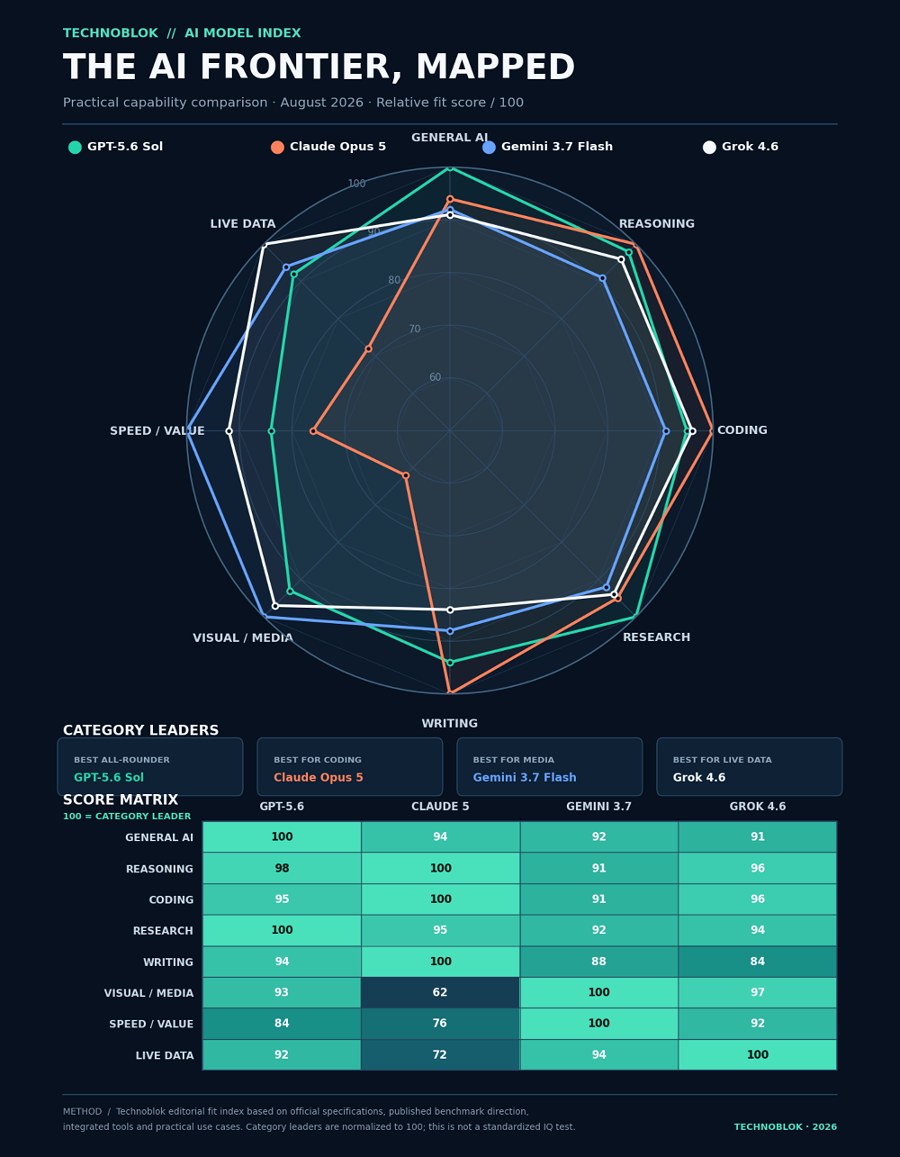
The short answer is that there is no universal winner. ChatGPT is currently the strongest all-round assistant, Claude is particularly impressive for coding and careful professional work, Gemini offers exceptional speed and value, while Grok stands out for real-time information and ambitious agentic projects.
Last updated: August 26, 2026.
Latest AI models compared
AI platform| Latest model| Best suited for| API context window| Main limitation
ChatGPT| GPT-5.6 Sol| General professional work, research, tools and complex reasoning| 1.05 million tokens| Premium reasoning can be expensive
Claude| Claude Opus 5| Coding, long documents, analysis and careful multi-step work| 1 million tokens| No native image or video output
Gemini| Gemini 3.7 Flash| Fast multimodal work, Google services and high-volume agents| 1.048 million tokens| Flash prioritizes efficiency over maximum reasoning
Grok| Grok 4.6| Real-time research, coding, interactive projects and X data| 500,000 tokens| Some new capabilities may reach developer products before the main chatbot
Context limits shown here are API limits. Consumer applications may apply different limits depending on the subscription and feature being used.
ChatGPT and GPT-5.6 Sol: the best all-round AI
GPT-5.6 Sol is OpenAI’s flagship model for complex professional work. It is part of a three-model family:
- Sol: The most capable model for demanding work
- Terra: A balanced model for everyday professional tasks
- Luna: The fastest and most affordable option
One of the biggest changes is that ChatGPT no longer needs to feel like a collection of separate “fast” and “thinking” models. GPT-5.6 Sol can deliver a quick response or spend more time reasoning, depending on the task. Users can also control how much thought the model applies.
OpenAI introduced Max reasoning for especially difficult problems and an Ultra mode that uses multiple sub-agents to divide and solve complex tasks. GPT-5.6 Sol also supports web search, file search, code execution, computer use, image generation tools, structured output and external integrations.
OpenAI says an updated GPT-5.6 Sol produced responses containing factual errors around 68% less often than GPT-5.5 Instant in an internal evaluation involving financial, medical and legal questions. It also provides more focused answers and adapts its level of detail more effectively.
Where ChatGPT performs best
- General everyday assistance
- Deep web research
- Data analysis and document creation
- Coding and cybersecurity work
- Image creation and editing
- Voice conversations
- Tasks requiring several different tools
- Users who want one AI platform for almost everything
GPT-5.6 Sol itself accepts text and images and produces text. Image, video, voice and computer-control capabilities are provided through additional tools integrated into ChatGPT and the OpenAI platform.
According to “OpenAI’s GPT-5.6 Sol documentation” (GPT-5.6 Sol Model | OpenAI API), the model has a 1.05-million-token context window and supports outputs of up to 128,000 tokens.
Verdict: ChatGPT remains the safest recommendation for users who want the broadest and most complete AI experience.
Claude Opus 5: the best for coding and careful professional work
Claude Opus 5 is Anthropic’s latest broadly available Opus model. Its greatest advantage is not simply generating an answer, but checking its own work and continuing to refine a task until it succeeds.
Anthropic has focused heavily on long-running software engineering, computer use, scientific research and professional analysis. Opus 5 is particularly effective at identifying the underlying cause of a problem instead of applying a superficial fix.
The model is also strong at maintaining requirements across large codebases and long conversations. Its one-million-token context window can accommodate extensive documentation, financial reports or a substantial software repository.
Opus 5 can understand text and images, but it does not natively generate conventional images or videos. Instead, Claude’s Artifacts feature can create editable applications, diagrams, visualizations, documents and interactive web experiences.
Where Claude performs best
- Large coding projects
- Debugging and root-cause analysis
- Technical writing and editing
- Financial and legal document analysis
- Scientific research
- Long, detailed source material
- Computer-use agents
- Work where judgment and self-verification matter
Anthropic reports that Opus 5 improved across all of its life-science evaluations compared with Opus 4.8. It also showed major gains in software engineering, business automation and computer-use tests. The company describes it as more proactive, consistent and willing to challenge a flawed assumption instead of simply agreeing with the user.
Claude Opus 5 supports a one-million-token context window, up to 128,000 output tokens and adjustable reasoning effort. It is also available in a Fast mode that runs approximately 2.5 times faster.
Full details are available in “Anthropic’s Claude Opus 5 announcement” (Introducing Claude Opus 5 \ Anthropic).
Verdict: Claude Opus 5 is arguably the strongest choice for serious coding, long documents and work that benefits from patient, critical reasoning.
Gemini 3.7 Flash: the fastest and best-value workhorse
Gemini 3.7 Flash is Google’s latest stable general-purpose Gemini model. Unlike models designed primarily to maximize benchmark scores regardless of cost, Gemini Flash is built to combine intelligence, speed and efficiency at scale.
It accepts text, images, audio, video and PDF documents. It also supports code execution, web search grounding, Google Maps grounding, file search, function calling and computer use in preview.
Google says Gemini 3.7 Flash delivers substantial improvements in debugging, issue resolution, production code, web development and complex document analysis compared with Gemini 3.6 Flash.
Its greatest practical advantage is Google integration. Gemini can work naturally with Search, Maps, Android and Google Workspace. Gemini Spark, Google’s persistent personal agent, can use the model to organize files, draft emails and update work documents.
Where Gemini performs best
- Google Workspace users
- Processing video, audio, images and PDFs
- Fast, high-volume AI applications
- Web and interface development
- Search and Maps-based tasks
- Large document collections
- Cost-sensitive API projects
- Automated business workflows
Gemini 3.7 Flash itself produces text rather than images or video. Google handles media generation through specialized models such as Nano Banana 2, Nano Banana Pro, Veo 3.1 and Gemini Omni Flash. This gives the wider Gemini ecosystem some of the most comprehensive media capabilities available.
The model supports up to 1,048,576 input tokens and 65,536 output tokens. Google’s introductory API pricing is $0.75 per million input tokens and $3.75 per million output tokens, making it considerably cheaper than the flagship models from OpenAI and Anthropic.
See the official “Gemini 3.7 Flash model documentation” (https://ai.google.dev/gemini-api/docs/models/gemini-3.7-flash) for its supported inputs and tools.
Verdict: Gemini 3.7 Flash offers the best combination of speed, multimodal understanding, ecosystem integration and price.
Grok 4.6: the best for live information and ambitious prototypes
Grok 4.6 is the latest frontier model from xAI, now operating as SpaceXAI. It focuses on long-running agents, coding, professional knowledge work and visually ambitious interactive projects.
The model can take a broad product idea, research an unfamiliar subject, structure an application, implement its main features and continue improving it through several rounds of feedback. xAI also reports better self-testing and verification than Grok 4.5.
Grok’s most recognizable advantage remains access to current information. Its web search and X Search tools can retrieve live websites, breaking news, trends and public posts from X. However, real-time information is supplied through search tools; it is not automatically present in the model’s static training data.
Where Grok performs best
- Breaking news and live trends
- Research involving posts on X
- Coding and rapid application prototypes
- Web development and interactive design
- Long-running agent tasks
- Creative, less formal conversations
- Image and video workflows through Grok Imagine
- Developers seeking a capable model at a moderate API price
Grok 4.6 accepts text and image inputs and produces text, with a 500,000-token context window. The wider Grok platform also provides image generation, image editing, video generation with audio and real-time voice tools.
In xAI’s published evaluations, Grok 4.6 matched GPT-5.6 Sol on the Artificial Analysis Intelligence Index, while results varied considerably across individual coding and professional benchmarks. API pricing starts at $2 per million input tokens and $6 per million output tokens for prompts below 200,000 tokens.
More information is available in the official “Grok 4.6 announcement” (Introducing Grok 4.6 | SpaceXAI) and “Grok product overview” (https://x.ai/grok).
Verdict: Grok is the strongest option for users who value real-time web and X information or want to turn broad ideas into working interactive prototypes.
Which AI is best for each task?
Task| Best choice| Why
Best overall AI assistant| ChatGPT| The most complete combination of reasoning, research, files, media and tools
Best AI for coding| Claude| Excellent codebase understanding, debugging and self-verification
Best AI for web research| ChatGPT| Strong deep research and source-based professional workflows
Best AI for breaking news| Grok| Live web search and direct X integration
Best AI for writing| Claude| Careful structure, tone control and strong editing
Best AI for Google Workspace| Gemini| Native integration with Google’s services
Best AI for multimodal analysis| Gemini| Native support for text, images, video, audio and PDFs
Best AI for image and video tools| Gemini or Grok| Strong specialized media-generation ecosystems
Best AI API value| Gemini| Very low introductory cost with a one-million-token context window
Best AI for long documents| Claude or ChatGPT| Large context windows and strong professional analysis
So, which one should you choose?
Choose ChatGPT if you want one assistant that can handle almost anything. It offers the most balanced combination of reasoning, research, coding, image creation, files, voice and agent tools.
Choose Claude if your priorities are software development, technical writing, large documents or careful professional analysis. It is especially good when an AI must inspect and improve its own work.
Choose Gemini if you use Google services, process a lot of multimedia content or need a fast and affordable model for repeated tasks.
Choose Grok if live events, X posts, rapid product development or a more direct conversational style are important to you.
For many professionals, the best solution is no longer choosing only one. A practical combination is Claude for coding and long-form analysis, ChatGPT for research and general work, Gemini for Google-based and multimodal workflows, and Grok for live trends.
Frequently asked questions
Is Claude better than ChatGPT?
Claude Opus 5 can be better for large coding projects, editing and long-document analysis. ChatGPT is more versatile overall because it combines reasoning with a broader selection of integrated research, media and productivity tools.
Which AI is best for coding in 2026?
Claude Opus 5 is the strongest general recommendation for difficult debugging and large codebases. GPT-5.6 Sol and Grok 4.6 are highly competitive for agentic coding, while Gemini 3.7 Flash offers excellent performance for its cost.
Which AI has the largest context window?
GPT-5.6 Sol, Claude Opus 5 and Gemini 3.7 Flash all support approximately one million API input tokens. Grok 4.6 supports 500,000 tokens.
Can all four AIs generate images?
Not through their main language models alone. ChatGPT, Gemini and Grok connect their language models to separate image-generation systems. Claude focuses on text, code, diagrams and interactive Artifacts rather than conventional image or video generation.
What is the best free AI?
Free limits and available models change frequently. ChatGPT, Claude, Gemini and Grok all provide some form of free access, but the best option depends on whether the priority is general use, coding, Google integration or real-time information.
Final verdict
There is no single AI model that wins every category.
ChatGPT is the best all-rounder. Claude is the most compelling choice for coding and careful professional work. Gemini delivers the best speed-to-cost ratio and multimodal integration. Grok is the most distinctive option for live information and rapid interactive development.
The real change in 2026 is that these systems are no longer competing only on who can write the best answer. They are competing on who can complete the most useful work.