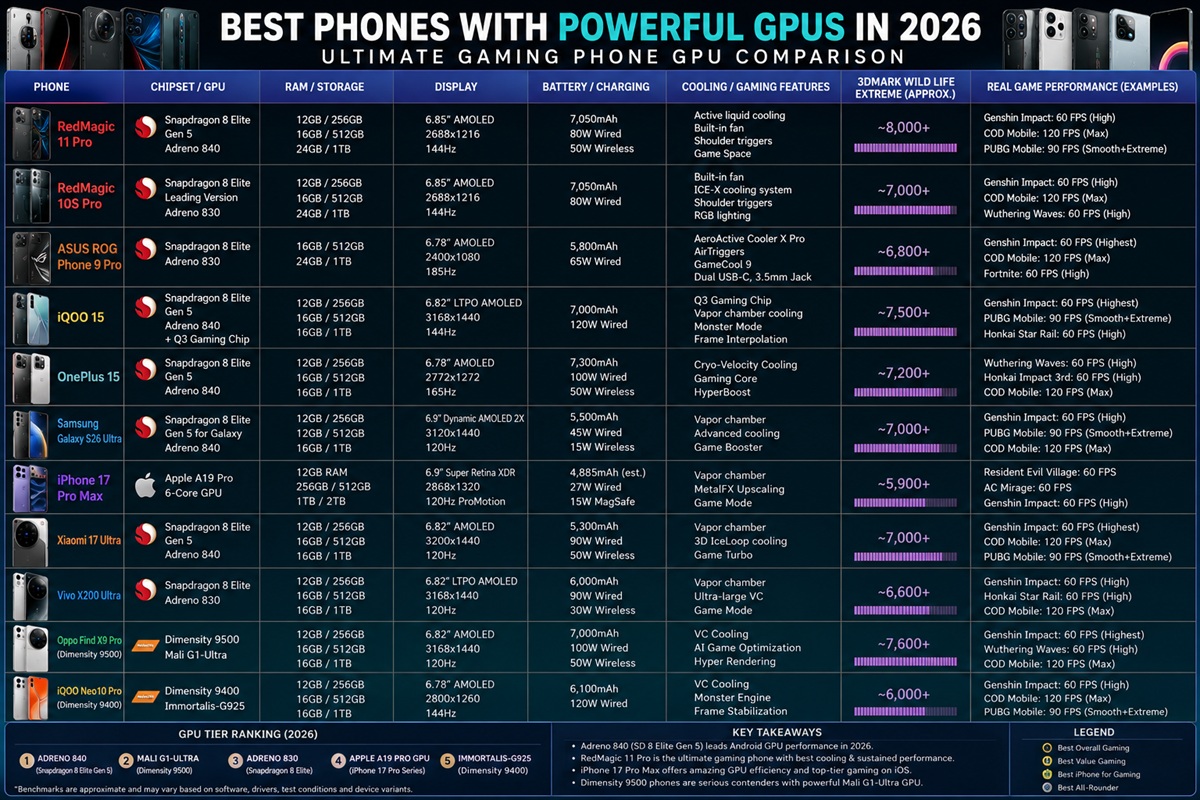
Most people don’t really think about the GPU inside a phone until a game starts dropping frames, the phone gets hot, or some “Ultra graphics” option suddenly disappears from the settings menu.
But in 2026, the mobile GPU is honestly one of the biggest things separating a normal flagship from a real gaming phone.
And yeah, technically every modern smartphone has a GPU. But that’s not what this list is about. This is about phones with serious mobile graphics power: Snapdragon Adreno GPUs, Apple’s A-series GPU, MediaTek/Arm Immortalis and Mali G1-Ultra chips, plus gaming phones with extra cooling, shoulder triggers, high refresh displays and sometimes even dedicated gaming co-processors.
So this isn’t just a “best phones” list. It’s more like:
Which phones actually have strong GPU performance?
Which models are built for gaming, not just camera marketing?
Which phones have benchmark data from other sources?
And which ones would you actually want for games like Genshin Impact, Wuthering Waves, PUBG Mobile, Call of Duty Mobile, Fortnite, Warzone Mobile, emulation or future ray tracing mobile games?
Let’s get into it.
Quick note: what does “GPU phone” really mean?
There is no mainstream phone with a removable NVIDIA or AMD desktop-style GPU. Phone graphics are built into the chipset, also called the SoC.
For example:
- Snapdragon phones use Adreno GPUs
- Apple iPhones use Apple-designed GPUs
- MediaTek Dimensity phones use Arm Immortalis / Mali GPUs
- Some gaming phones add extra chips for frame interpolation, upscaling or touch response
So when people search for “phones with GPU”, “best mobile GPU phone” or “gaming phone GPU benchmark”, they usually mean phones with the strongest integrated graphics processor.
That’s what this list focuses on.
Best GPU Phones and Gaming Phones in 2026
| Phone | Chipset / GPU | Gaming features | Benchmark / performance notes | Best for |
|---|---|---|---|---|
| RedMagic 11 Pro | Snapdragon 8 Elite Gen 5 / Adreno 840 | Active liquid cooling, fan-style gaming design, shoulder triggers, 144Hz AMOLED, up to 24GB RAM | One of the strongest Android gaming phones; 3DMark Wild Life Extreme scores around the 8,000 range in review testing | Pure gaming, long sessions, FPS titles |
| RedMagic 10S Pro / 10S Pro+ | Snapdragon 8 Elite Leading Version / Adreno 830 | Built-in fan, 144Hz display, shoulder triggers, gaming mode, huge battery | Wild Life Extreme around 7,000+ in some tests; very strong sustained gaming | Best-value gaming beast |
| ASUS ROG Phone 9 Pro / Pro Edition | Snapdragon 8 Elite / Adreno 830 | AirTriggers, AeroActive Cooler support, 185Hz AMOLED, second USB-C port, headphone jack | One of the most complete gaming phones; built more like a handheld than a normal flagship | Premium gaming phone experience |
| iQOO 15 | Snapdragon 8 Elite Gen 5 / Adreno 840 + Q3 gaming chip | Dedicated gaming chip, 2K 144Hz display, frame interpolation, ray tracing effects, large battery | Strong gaming-focused flagship; Q3 chip helps with graphics enhancement and frame features | High FPS gaming without full “gamer phone” design |
| OnePlus 15 | Snapdragon 8 Elite Gen 5 / Adreno 840 | 165Hz display, large 7,300mAh battery, performance tuning, gaming core features | Real-game tests show near-60 FPS in heavy titles like Wuthering Waves and Honkai Impact 3rd | Balanced flagship + gaming |
| Samsung Galaxy S26 Ultra | Snapdragon 8 Elite Gen 5 for Galaxy / Adreno 840 | Large LTPO AMOLED display, flagship cooling, premium build, long software support | UL benchmark listings show it near the top of current Android performance charts | Gaming + camera + daily flagship |
| iPhone 17 Pro Max | Apple A19 Pro / 6-core Apple GPU | Vapor chamber cooling, strong Metal API performance, high-end game support, Apple Arcade | A19 Pro GPU performs strongly in 3DMark Wild Life Extreme and Geekbench Metal; great efficiency | iOS gaming, console-style mobile games |
| iPhone 17 Pro | Apple A19 Pro / 6-core Apple GPU | Same chip family as Pro Max, vapor chamber, smaller body | Excellent GPU power, but smaller size may affect heat over long sessions | Compact premium gaming |
| Xiaomi 17 Ultra | Snapdragon 8 Elite Gen 5 / Adreno 840 | Large flagship display, premium cooling, high-end camera hardware | Listed in UL benchmark charts among top Snapdragon 8 Elite Gen 5 devices | Camera flagship with serious GPU |
| Xiaomi 17 Pro Max | Snapdragon 8 Elite Gen 5 / Adreno 840 | Large display, flagship battery and cooling | Strong benchmark placement, though gaming features are less aggressive than RedMagic/ROG | Flagship gaming + media |
| Xiaomi 17 Pro | Snapdragon 8 Elite Gen 5 / Adreno 840 | Compact flagship layout, high-end chipset | Strong GPU, but compact body may throttle sooner than big gaming phones | Smaller flagship power |
| Honor GT Pro | Snapdragon 8 Elite / Adreno 830 | Performance-focused Android flagship | Appears high in UL smartphone benchmark lists | Value/performance flagship |
| Vivo X200 Ultra | Snapdragon 8 Elite / Adreno 830 | Premium camera flagship, high-end cooling | Strong GPU, but not a pure gaming phone | Camera-first flagship that can game hard |
| Oppo Find X9 Pro / Dimensity 9500 phones | Dimensity 9500 / Arm Mali G1-Ultra | Strong GPU, good efficiency, flagship display | Some benchmark comparisons show Dimensity 9500 beating Snapdragon 8 Elite Gen 5 in certain graphics and ray tracing tests | Android users who want MediaTek’s best GPU |
| Oppo Find X8 / Vivo X200 / iQOO Neo10 Pro | Dimensity 9400 / Immortalis-G925 MC12 | High-end MediaTek GPU, flagship-class graphics | Immortalis-G925 still performs very well in Wild Life Extreme-type tests | Cheaper flagship gaming option |
1. RedMagic 11 Pro — the most obvious “this is a gaming phone” choice
The RedMagic 11 Pro is probably the easiest phone to explain on this list.
It doesn’t pretend to be a lifestyle camera phone first. It’s a gaming phone. Big display, huge battery, aggressive cooling, shoulder triggers, high refresh rate, strong GPU, RGB-heavy design options, and that whole “mini handheld console” vibe.
The important part is the chipset: Snapdragon 8 Elite Gen 5 with Adreno 840.
That puts it right at the top of Android GPU performance right now. But the bigger deal is cooling. A normal flagship can have the same chip and still lose performance after 15–20 minutes if heat builds up. RedMagic’s whole point is keeping the chip boosted for longer.
The RedMagic 11 Pro also uses a gaming-focused cooling system, and some reviews report very high 3DMark results, with Wild Life Extreme scores around the 8,000 mark. That’s serious mobile GPU territory.
This is the kind of phone you buy if you mostly care about:
- FPS games
- MOBA games
- emulation
- high refresh gaming
- long gaming sessions
- less throttling
- shoulder triggers
- raw Android gaming power
The downside? Cameras and software polish are usually not the main reason to buy RedMagic. You buy it for performance.
Still, if someone asks “what is the best phone GPU for gaming?”, RedMagic 11 Pro has to be near the top.
2. RedMagic 10S Pro / 10S Pro+ — still a monster, and probably better value
The RedMagic 10S Pro is still very interesting because it uses the Snapdragon 8 Elite Leading Version, basically a boosted version of the Snapdragon 8 Elite generation.
It has the Adreno 830 GPU, not the newer Adreno 840, but don’t write it off. The benchmark data is still very strong, with some tests showing Wild Life Extreme scores around 7,000+.
The phone also has:
- 6.85-inch 144Hz display
- built-in cooling fan
- shoulder triggers
- large 7,050mAh battery
- up to 24GB RAM options
- UFS 4.1 storage
- gaming mode features
For most real-world Android games, this is already overkill. PUBG Mobile, COD Mobile, Genshin Impact, Honkai Star Rail, Wuthering Waves, Fortnite-style titles — the chip is not the weak point here.
The real question is price. If the RedMagic 11 Pro is expensive or unavailable in your region, the 10S Pro could still be one of the smartest GPU phone picks.
It’s not the newest, but it’s still properly built for games.
3. ASUS ROG Phone 9 Pro — the polished gaming phone
The ROG Phone line has always felt like the “premium gaming laptop” version of a phone.
The ROG Phone 9 Pro runs on Snapdragon 8 Elite with Adreno 830, and ASUS gives it a lot of gaming-specific hardware:
- 185Hz AMOLED display
- AirTriggers
- AeroActive Cooler support
- second USB-C port
- headphone jack
- large 5,800mAh battery
- up to 24GB RAM on some versions
- strong thermal design
That second USB-C port sounds small, but if you actually game with a controller, charger, or cooler attached, it matters. Same with the headphone jack. Gaming phones are one of the few places where these old “extra” features still make sense.
The ROG Phone 9 Pro may not always beat RedMagic in raw benchmark-per-dollar value, but it feels more refined. The software, accessories and gaming ecosystem are a big part of the appeal.
If RedMagic is the wild performance monster, ROG Phone is the more polished gaming device.
4. iQOO 15 — flagship phone with a dedicated gaming chip
The iQOO 15 is one of the more interesting phones here because it doesn’t look as extreme as RedMagic or ROG, but it still goes very hard on performance.
It uses:
- Snapdragon 8 Elite Gen 5
- Adreno 840 GPU
- iQOO Q3 gaming chip
- 2K+ 144Hz display
- big battery
- fast charging
- gaming frame interpolation and graphics enhancement features
The dedicated Q3 chip is the main talking point. It is designed to help with things like frame interpolation, super-resolution, rendering support and better gaming efficiency.
This is exactly the kind of phone that makes the “gaming phone vs flagship phone” line blurry.
It’s not a pure gaming phone in the same way RedMagic is, but it has enough gaming hardware to make normal flagships look lazy.
If you want a phone that can be used daily without screaming “gamer” from 10 meters away, but you still care about mobile GPU performance, iQOO 15 is one of the strongest options.
5. OnePlus 15 — the balanced performance flagship
The OnePlus 15 is not a traditional gaming phone, but it deserves a place here.
It uses Snapdragon 8 Elite Gen 5 with Adreno 840, which means the raw GPU power is flagship-level. OnePlus also pushes gaming features with its performance engine and high refresh display.
The big advantages:
- 6.78-inch OLED display
- up to 165Hz refresh rate
- huge 7,300mAh battery
- Snapdragon 8 Elite Gen 5
- LPDDR5X Ultra+ / UFS 4.1-class storage
- strong real-game performance
Some gaming performance analysis showed the OnePlus 15 holding around 60 FPS in demanding titles such as Honkai Impact 3rd and Wuthering Waves, with power draw and temperature numbers that looked competitive against iPhone 17 Pro Max and Dimensity 9500 devices.
That’s the kind of data that matters more than just AnTuTu screenshots.
For most people, OnePlus 15 might be the better buy than a dedicated gaming phone because it still works as a normal premium phone: good battery, good screen, good software, good daily usability.
Not every gamer wants RGB lights and a fan.
6. Samsung Galaxy S26 Ultra — not a gaming phone, but still a GPU beast
The Galaxy S26 Ultra is not marketed as a gaming phone first. It’s a premium flagship. Camera, display, AI features, S Pen-style productivity, long support — that’s the Samsung Ultra identity.
But with Snapdragon 8 Elite Gen 5 for Galaxy and Adreno 840, it still belongs in any serious mobile GPU list.
The “for Galaxy” version usually means a slightly tuned Qualcomm chip, and benchmark listings show the Galaxy S26 Ultra near the top of current Android GPU/device charts.
Why pick it for gaming?
Because you also get:
- one of the best displays on any phone
- strong speakers
- premium build
- good cooling for a mainstream flagship
- long update support
- flagship camera system
- stable global availability
The downside is simple: it’s not designed around gaming controls. No shoulder triggers, no built-in fan, no aggressive gaming shape.
Still, if someone wants the best all-round Android phone that can also play almost anything at high settings, the Galaxy S26 Ultra is one of the safest picks.
7. iPhone 17 Pro Max — Apple’s strongest mobile GPU option
The iPhone 17 Pro Max uses the A19 Pro with a 6-core Apple GPU, and Apple finally taking vapor chamber cooling seriously makes it more interesting for gaming than older iPhones.
The iPhone has a different advantage from Android gaming phones. It doesn’t always chase the craziest cooling hardware or highest refresh numbers, but Apple’s chip efficiency and Metal API optimization can be excellent.
For games that are well optimized on iOS, the iPhone 17 Pro Max can feel extremely smooth.
It also has access to some console-style mobile ports and Apple Arcade titles that run very well on Apple silicon.
Why it’s good:
- A19 Pro GPU is very strong
- great efficiency
- good sustained performance with vapor chamber
- strong developer support
- premium display and speakers
- long software support
Why some Android gaming phones still win:
- fewer gamer controls
- no built-in fan
- less freedom for emulation
- limited sideloading depending on region
- usually expensive
If you’re inside the Apple ecosystem and want the strongest iPhone for gaming, this is the one.
8. iPhone 17 Pro — smaller, still powerful
The iPhone 17 Pro gets the same A19 Pro GPU class, so it deserves a separate mention.
But the smaller body matters. Less space usually means heat is harder to manage, especially during long gaming sessions. So while short benchmark runs can look excellent, the Pro Max is probably the safer gaming pick if you care about sustained performance.
Still, for a compact phone, the iPhone 17 Pro is one of the strongest GPU phones available.
It’s not a “gaming phone,” but it’s absolutely a powerful gaming device.
9. Xiaomi 17 Ultra — camera flagship with flagship GPU power
Xiaomi’s Ultra phones are usually known for cameras, but the Xiaomi 17 Ultra also appears in top benchmark listings with Snapdragon 8 Elite Gen 5 and Adreno 840.
That makes it a serious GPU phone even if it’s not sold as a gaming device.
The interesting thing about phones like this is that you get high graphics performance without sacrificing camera hardware. RedMagic might beat it in cooling and triggers, but Xiaomi Ultra gives you a more complete flagship package.
This kind of phone is for someone who wants:
- strong gaming
- elite camera hardware
- big premium display
- fast storage
- modern Android flagship features
The possible downside is thermal behavior. Camera-focused flagships may not always sustain GPU load like RedMagic or ROG.
Still, if Xiaomi tunes the cooling well, the 17 Ultra is easily one of the most powerful Android phones for gaming and media.
10. Xiaomi 17 Pro Max — big screen, big battery, serious GPU
The Xiaomi 17 Pro Max is another Snapdragon 8 Elite Gen 5 / Adreno 840 phone that appears in high-end benchmark lists.
It’s not as gaming-focused as RedMagic, but it has the hardware needed for top-tier Android gaming.
The bigger body should also help with heat compared to smaller models, though real-world throttling always depends on cooling design.
This is one of those phones that could be great for people who want gaming performance but don’t want the styling of a dedicated gaming phone.
11. Xiaomi 17 Pro — compact flagship, powerful but watch the thermals
The Xiaomi 17 Pro is interesting because it brings the same high-end Snapdragon platform into a smaller body.
That’s both good and bad.
Good because it means you get Adreno 840-class GPU power in a more pocketable phone.
Bad because compact phones usually have less room for heat dissipation. For casual gaming, it should be excellent. For 60-minute heavy gaming sessions, bigger phones like the Pro Max, RedMagic or ROG may hold performance better.
So yes, it’s a powerful GPU phone, but not necessarily the best gaming phone.
12. Honor GT Pro — performance-focused Android option
Honor GT Pro appears in benchmark lists with Snapdragon 8 Elite and Adreno 830, placing it among strong Android performers.
This one is worth watching because GT-style phones often aim for price-to-performance rather than camera-first flagship marketing.
That means you may get strong chipset performance, a good display, fast charging and a competitive price.
It may not have the same global availability or gaming identity as RedMagic or ROG, but from a GPU point of view, it belongs in the conversation.
13. Vivo X200 Ultra — powerful GPU, camera-first personality
The Vivo X200 Ultra is another example of a high-end flagship that can game very well even if gaming isn’t the main selling point.
With Snapdragon 8 Elite and Adreno 830, it has enough graphics power for demanding Android games.
But again, this is not the same as a dedicated gaming phone. You pick Vivo X200 Ultra because you want a premium camera flagship that also has high-end GPU power.
If gaming is your first priority, RedMagic or ROG makes more sense.
If you want camera + display + strong performance, Vivo becomes more interesting.
14. Dimensity 9500 phones — MediaTek is not playing around anymore
A few years ago, a lot of people automatically picked Snapdragon for gaming. That’s still common, but MediaTek’s top chips are no joke now.
Dimensity 9500 with Arm Mali G1-Ultra graphics has shown strong GPU numbers in some comparisons, even beating Snapdragon 8 Elite Gen 5 in certain 3DMark graphics and ray tracing-style tests.
That does not mean every Dimensity 9500 phone is automatically better for gaming.
Cooling, drivers, game optimization and manufacturer tuning still matter.
But if you see a phone with Dimensity 9500, don’t dismiss it just because it’s not Snapdragon. For mobile GPU benchmarks and gaming efficiency, MediaTek is now very serious.
This is especially interesting for people searching things like:
- Snapdragon vs Dimensity gaming
- Dimensity 9500 GPU benchmark
- best MediaTek gaming phone
- mobile ray tracing phone
15. Dimensity 9400 phones — still strong, especially if the price is right
Phones using Dimensity 9400 and Immortalis-G925 are still strong gaming devices.
Examples include models like Oppo Find X8, Vivo X200 and iQOO Neo10 Pro depending on region.
The Immortalis-G925 GPU supports modern graphics features, including hardware ray tracing support, and benchmark data still puts it in a high-end category.
These phones may become more interesting as prices drop. They won’t always beat the newest Snapdragon 8 Elite Gen 5 phones, but for the money, they can still be excellent.
If the price difference is big, a Dimensity 9400 phone could be the smarter gaming buy.
Mobile GPU benchmark comparison
These benchmark numbers are not perfect, because scores change depending on cooling, RAM, software version, benchmark mode and whether the phone is in performance mode.
Still, they give a useful idea of the current mobile GPU landscape.
| GPU / Platform | Typical phone examples | 3DMark Wild Life Extreme Unlimited / similar notes | What it means in real use |
|---|---|---|---|
| Adreno 840 | Snapdragon 8 Elite Gen 5 phones: RedMagic 11 Pro, OnePlus 15, Galaxy S26 Ultra, Xiaomi 17 series | Notebookcheck lists Adreno 840 around 6,100–8,200+ in Wild Life Extreme Unlimited, with average around 7,200+ | Current Android GPU leader class |
| Mali G1-Ultra MC12 | Dimensity 9500 phones | Notebookcheck lists average around 6,800+ and max around 7,600+ in Wild Life Extreme Unlimited | Very strong MediaTek GPU, especially interesting for sustained graphics |
| Adreno 830 | Snapdragon 8 Elite phones: ROG Phone 9 Pro, RedMagic 10S Pro, Vivo X200 Ultra, Honor GT Pro | Notebookcheck lists average around 6,200+ and max around 7,200+ in Wild Life Extreme Unlimited | Still flagship-level, very good for gaming |
| Apple A19 Pro 6-core GPU | iPhone 17 Pro / Pro Max | Notebookcheck lists Wild Life Extreme Unlimited around 5,900+ average | Strong iOS GPU, excellent optimization and efficiency |
| Immortalis-G925 MC12 | Dimensity 9400 phones | Notebookcheck lists average around 6,000+ in Wild Life Extreme Unlimited | Still very strong, especially if priced below newer flagships |
So which one is actually the best?
Depends what you want.
Best pure gaming phone
RedMagic 11 Pro
If the goal is maximum gaming performance, cooling, triggers and long sessions, this is the most obvious pick.
Best polished gaming phone
ASUS ROG Phone 9 Pro
More premium, more refined, better accessory ecosystem. Not always the cheapest, but very complete.
Best normal flagship for gaming
OnePlus 15
Huge battery, strong Snapdragon 8 Elite Gen 5 GPU, high refresh display and good real-game performance.
Best iPhone for gaming
iPhone 17 Pro Max
A19 Pro GPU, vapor chamber, strong Metal performance and long software support.
Best camera flagship that can still game hard
Samsung Galaxy S26 Ultra / Xiaomi 17 Ultra / Vivo X200 Ultra
These are not gaming-first phones, but the GPU power is there.
Best value if priced well
RedMagic 10S Pro / Dimensity 9400 flagships
Older doesn’t mean weak. If the price is good, these can be smarter than buying the newest phone.
The part nobody should ignore: cooling matters more than people think
A lot of phones can hit a huge benchmark score once.
That doesn’t mean they can hold that performance.
Gaming phones like RedMagic and ROG exist because heat is the real enemy. Once the phone gets hot, the system reduces CPU and GPU clocks. That’s throttling.
So when comparing phone GPUs, don’t just ask:
“What is the fastest mobile GPU?”
Also ask:
“Which phone keeps that GPU fast after 30 minutes?”
That’s why a gaming phone with slightly older hardware can sometimes feel better than a newer thin flagship in long sessions.
For short gaming: most flagships are fine.
For long gaming: cooling wins.
Final thoughts
The best GPU phone in 2026 is not only about the chip name.
Snapdragon 8 Elite Gen 5 and Adreno 840 are clearly at the top of Android right now, but Apple’s A19 Pro is still extremely strong on iOS, and MediaTek’s Dimensity 9500 / Mali G1-Ultra performance proves that Snapdragon is no longer the only serious choice for mobile gaming.
If I had to split the list into simple categories:
- Hardcore gaming: RedMagic 11 Pro
- Premium gaming: ROG Phone 9 Pro
- Balanced daily flagship: OnePlus 15
- iPhone gaming: iPhone 17 Pro Max
- All-round Android flagship: Galaxy S26 Ultra
- Best value hunter pick: RedMagic 10S Pro or a discounted Dimensity 9400 flagship
But the real question is this:
Would you rather have a full gaming phone with triggers and cooling, or a normal flagship that just happens to have monster GPU power?
Because honestly, that’s where the debate gets fun.
Sources
- UL Benchmarks smartphone rankings and device benchmark database: (Benchmarks UL)
- Notebookcheck GPU benchmark database for Adreno 840, Adreno 830, Apple A19 Pro GPU, Mali G1-Ultra and Immortalis-G925: (Notebookcheck)
- RedMagic 11 Pro and RedMagic 10S Pro official specifications: (REDMAGIC)
- RedMagic 11 Pro and 10S Pro review / benchmark references: (Neowin)
- ASUS ROG Phone 9 Pro official specifications and gaming features: (@ROG)
- OnePlus 15 official specifications and gaming performance references: (OnePlus)
- iQOO 15 Q3 gaming chip and specifications references: (Notebookcheck)
- Snapdragon 8 Elite Gen 5 / Dimensity 9500 benchmark comparisons: (Android Authority)
- iPhone 17 Pro / A19 Pro performance references: (tomshardware.com)