For decades, Moon bases mostly belonged to science fiction.
Huge domes on the lunar surface.
Permanent colonies.
Rovers driving across endless gray landscapes.
Humans living off-world for months or even years.
NASA talked about those ideas many times before, but most of them never moved beyond concepts, presentations and long-term dreams.
Now something feels different.
NASA has officially revealed a phased Moon Base strategy tied directly to the Artemis program, and for the first time the agency is talking openly about building infrastructure that could eventually support a continuous human presence on the Moon. Not temporary visits. Not short Apollo-style missions.
Staying.
And honestly, the scale of what they’re describing is much bigger than many people realize.
NASA Is Thinking Bigger Than a Small Lunar Outpost
When most people hear “Moon base,” they probably imagine a compact station with a few astronauts living inside a small habitat.
That’s not really what NASA is describing anymore.
According to NASA’s newer Moon Base plans, the long-term lunar infrastructure could eventually stretch across hundreds of square miles near the Moon’s south pole.
That sounds insane at first.
But once NASA explained the reasoning, it actually starts making sense.
Different systems need large separation distances:
- habitats,
- power generation systems,
- landing zones,
- scientific facilities,
- communication infrastructure,
- resource extraction areas,
- autonomous exploration networks.
You can’t simply place everything next to each other.
Especially when you’re dealing with:
- radiation,
- dust contamination,
- rocket landings,
- nuclear power systems,
- long-term expansion planning.
NASA is essentially planning an entire operational region rather than a single building.
That’s a completely different level of ambition compared to anything humanity has ever built outside Earth.
Why the Lunar South Pole Matters So Much
NASA isn’t choosing the south pole randomly.
The region is considered one of the most valuable locations in the entire Solar System.
The biggest reason?
Water ice.
Scientists believe large amounts of frozen water exist inside permanently shadowed craters near the lunar south pole.
And water changes everything.
Water can provide:
- drinking supplies,
- oxygen production,
- hydrogen fuel,
- life support systems,
- future rocket propellant.
Without local resources, every kilogram must be launched from Earth.
That’s incredibly expensive.
If astronauts can produce oxygen and fuel directly on the Moon, lunar operations become dramatically more sustainable.
Suddenly the Moon stops being just a destination.
It becomes a supply station.
And that has enormous implications for future Mars missions.
The Moon Is Becoming a Mars Test Ground
A lot of people still think Artemis is mainly about returning humans to the Moon.
That’s only part of the story.
NASA increasingly talks about the Moon as a testing environment for Mars exploration.
Living on another world introduces problems humans have never solved before at scale:
- long-term isolation,
- radiation exposure,
- limited supplies,
- equipment failures,
- autonomous operations,
- resource production,
- psychological stress.
The Moon allows NASA to experiment with those challenges while remaining relatively close to Earth.
Mars is millions of kilometers away.
The Moon is only a few days away.
If something goes catastrophically wrong, rescue is at least theoretically possible.
That makes the lunar surface the perfect proving ground.
In many ways, NASA’s Moon Base might become humanity’s rehearsal for Mars.
MoonFall Drones Might Become the First Lunar Scouts
One of the most fascinating parts of NASA’s announcement involves something that sounds almost like a video game mechanic.
Hopping drones.
NASA selected Firefly Aerospace to develop MoonFall drones that won’t fly like normal drones on Earth. Instead, they will hop across the lunar surface, scouting terrain and helping define the future Moon Base perimeter.
Traditional drone flight is difficult on the Moon because there is essentially no atmosphere.
No air means no normal helicopter-style lift.
So NASA is experimenting with alternative mobility systems capable of navigating craters, steep terrain and difficult exploration zones.
These drones may become some of the first robotic pioneers mapping future human expansion areas.
And honestly, that’s one of the coolest parts of the entire project.
Before astronauts spread across the lunar south pole, tiny autonomous scouts could already be there exploring ahead of them.
Lunar Rovers Are Becoming Entire Exploration Systems
NASA is also investing heavily in next-generation lunar vehicles.
This isn’t just about replacing the old Apollo moon buggy.
The new Lunar Terrain Vehicles (LTVs) are expected to operate both with and without astronauts onboard.
That means they can:
- transport cargo,
- scout routes,
- support scientific missions,
- move equipment,
- prepare infrastructure before crews arrive.
NASA awarded major contracts to companies including:
- Lunar Outpost,
- Astrolab,
- Blue Origin,
- Firefly Aerospace.
Future rover systems may travel far beyond the immediate base area.
Some NASA research projects are already exploring navigation systems designed for extremely long-range lunar travel using crater-based positioning rather than Earth-style GPS.
Because there is no GPS network on the Moon.
That’s another problem humans need to solve from scratch.
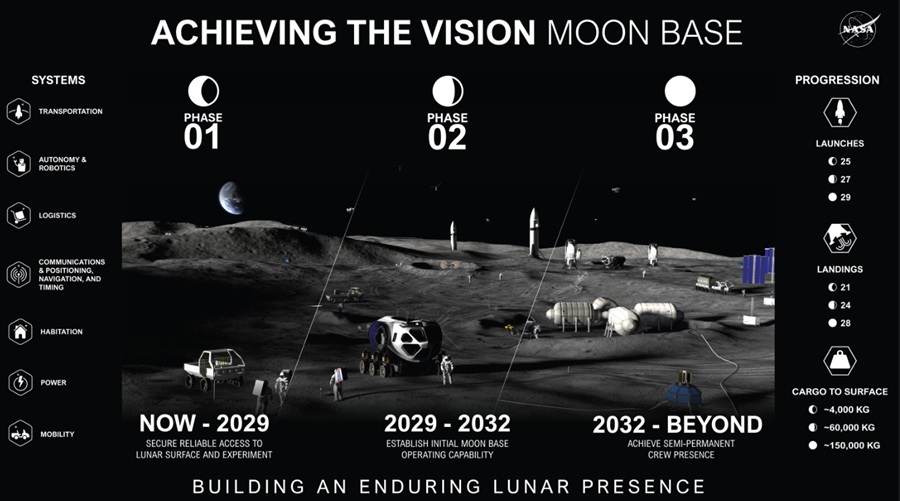
NASA’s Three-Phase Moon Base Strategy
NASA’s roadmap is divided into three major phases.
Phase One: Now Through 2029
This phase focuses on:
- robotic exploration,
- technology demonstrations,
- early infrastructure,
- resource analysis,
- testing vehicles and systems.
Think of it as preparation.
NASA wants robots to learn the terrain before humans begin long-term operations.
Phase Two: 2029–2032
This is where things start becoming serious.
NASA plans:
- permanent infrastructure,
- energy systems,
- logistics networks,
- larger exploration capabilities,
- expanded operational zones.
This phase begins transforming exploration into actual occupation.
Phase Three: 2032 and Beyond
This is the real goal.
A sustained human presence.
Not occasional visits.
Not flags and footprints.
Humans living and working on the Moon for extended periods.
That may become the biggest shift in human exploration since Apollo.
China Is Quietly Changing the Equation
One thing NASA doesn’t always say directly, but it’s impossible to ignore:
China is a major reason these plans are accelerating.
China has its own lunar ambitions.
Its own lunar research station plans.
Its own growing space infrastructure.
For the first time in decades, the United States faces something resembling a new space race.
Not identical to the Cold War.
But similar enough.
Being first matters.
Building standards matters.
Claiming leadership matters.
Especially when future lunar resources and infrastructure may influence the next century of space development.
The Moon is starting to look less like a scientific destination and more like strategic territory.
The Engineering Problems Are Brutal
Of course, building a Moon Base isn’t just difficult.
It’s borderline absurd.
Engineers still need solutions for:
- radiation shielding,
- lunar dust contamination,
- power generation,
- thermal management,
- food production,
- maintenance logistics,
- emergency medical support.
Even micrometeorites remain a major threat.
Research suggests a lunar base could experience thousands of micrometeoroid impacts annually, requiring advanced shielding systems to protect long-term habitats.
Every simple task on Earth becomes dramatically harder on the Moon.
Repairing a pipe.
Replacing equipment.
Charging vehicles.
Growing food.
Nothing is simple anymore.
This Could Become Humanity’s Biggest Construction Project
What’s fascinating is that NASA isn’t talking about a mission anymore.
They’re talking about infrastructure.
That changes the entire mindset.
Apollo was an expedition.
Moon Base is construction.
Long-term planning.
Supply chains.
Maintenance.
Expansion.
Those are words normally associated with cities, not space programs.
If NASA actually succeeds, future generations may look back at the Artemis era the same way we look back at the earliest transcontinental railroads or the first ocean-crossing exploration routes.
The beginning of something much larger than people realized at the time.
Final Thoughts
A few years ago, a permanent Moon Base still sounded like futuristic marketing.
Now NASA is signing contracts.
Building hardware.
Testing rovers.
Developing drones.
Planning infrastructure.
Designing expansion phases.
For the first time in decades, humanity’s return to the Moon doesn’t feel temporary.
It feels like the opening chapter of something bigger.
The strange part is that we may be watching the beginning of a completely new era without fully realizing it yet.
Because if Moon Base succeeds, the story won’t really be about the Moon.
The Moon will just be the first step.
The real destination has always been much farther away.
Mars.
And maybe, eventually, beyond that.
Sources: NASA Moon Base Program, Artemis Program updates, NASA Moon Base Phases, Space.com, Associated Press, Reuters, NASA technical architecture documents.