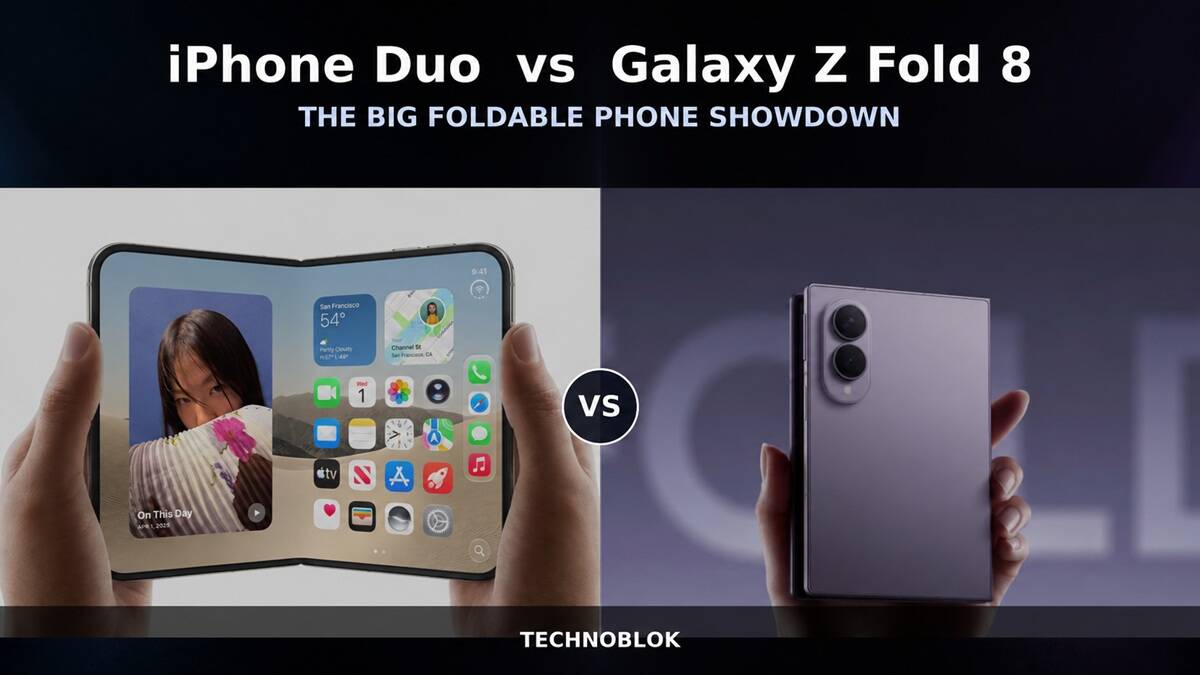
Apple’s been sitting out the foldable phone game for years while Samsung quietly iterated through eight generations of the Fold line. That changes now with iPhone Duo — Apple’s first real swing at a book-style foldable, launching right into a market Samsung basically built from scratch.
Both phones land around $2,000 in the US and both pack a 7.6-inch inner display, so on paper they look like twins. Spend five minutes with the specs, though, and they turn out to be pretty different devices — different priorities, different trade-offs, different ideas about what a foldable should even be.
Build and durability: Samsung’s years of iteration show
Weight and thickness matter more in a foldable than in almost any other phone category, because you feel every gram when you’re holding something book-sized open in one hand.
iPhone Duo comes in at 5.2mm unfolded, 11.3mm folded, and 254 grams. Galaxy Z Fold 8 is noticeably slimmer and lighter — 4.5mm unfolded, 9.7mm folded, 201 grams. That 53-gram gap sounds small until you’re holding the phone open to read something for twenty minutes, at which point it’s very much not small.
Apple’s using titanium for the frame and hinge cover, with Ceramic Shield front and back. Samsung’s gone with an aluminum frame, Gorilla Glass Victus 2, and what they’re calling Flex Titanium reinforcing the fold itself.
Durability ratings flip the script though — iPhone Duo carries IP68, Galaxy Z Fold 8 only IP48. IP48 still covers water fine, but it doesn’t guarantee protection against dust particles under 1mm, which matters if you’re the type who takes your phone to the beach or a job site.
Worth flagging: iPhone Duo hasn’t been through any independent long-term durability testing yet. The IP rating looks good on paper, but nobody knows how the hinge holds up after a few thousand folds, or whether that crease stays invisible after six months of daily use. Samsung’s eight generations of iteration count for something real here — Apple’s still got to prove itself.
Displays: same size, different bets
Both phones ship with a 7.6-inch main display, but they get there differently.
iPhone Duo runs a 7.6-inch Super Retina XDR OLED inner panel and a 5.4-inch OLED outer screen, both at 120Hz ProMotion and 3,000 nits peak brightness. Apple’s talking up a nano-texture anti-reflective coating and a 10-layer ultra-thin stack for the fold itself. Early hands-on impressions noted the crease is barely visible — genuinely impressive for a first-gen attempt. Whether that holds up after months of real use is the open question.
Galaxy Z Fold 8 pairs a 7.6-inch Dynamic AMOLED 2X inner display with a 5.5-inch outer screen, also 120Hz and roughly 3,000 nits. Samsung’s outer screen is marginally wider, which sounds trivial but actually helps for quick notification checks and one-handed replies.
Net-net: Apple’s promising a less visible crease and slightly higher resolution, Samsung’s offering similarly-sized panels in a thinner, lighter body it’s had years to refine.
S Pen support is the one clear differentiator
This one’s not close. iPhone Duo works with the USB-C Apple Pencil, which opens up note-taking, PDF markup, and sketching on that big inner screen — genuinely useful if you’re trying to use this thing as a tablet replacement.
Galaxy Z Fold 8 drops S Pen support entirely this generation. Some earlier Fold models supported a stylus; cutting it from the standard lineup is a real loss for anyone who wanted the foldable specifically for note-taking or drawing.
Performance and software: raw power vs. years of polish
iPhone Duo runs Apple’s A20 Pro, built on a 2nm process, paired with iOS 27. Apple’s built foldable-specific UI modes — running two apps side by side, drag-and-drop between them, and interface adjustments depending on how you’ve got the phone angled.
Galaxy Z Fold 8 runs Snapdragon 8 Elite Gen 5 for Galaxy with Android 17 and One UI 9. Samsung’s real edge here isn’t the chip — it’s eight generations of software iteration specifically for foldables. Multi-window management, app layout presets, using the big screen efficiently — Samsung’s had years to work the kinks out.
Apple’s hardware-software integration has historically been strong, but iPhone Duo is a first-gen foldable. How fast third-party developers adapt their apps to actually work well on the fold — rather than just stretching a phone UI awkwardly — will shape a lot of the real-world experience here.
On AI: Galaxy Z Fold 8 runs Galaxy AI plus Gemini integration. iPhone Duo has Apple Intelligence and the new Siri AI, though Apple’s confirmed the new Siri features launch in English first — worth knowing if you’re not in an English-speaking market and were counting on that being a selling point.
Cameras
iPhone Duo packs 48MP main and 48MP ultra-wide sensors, no dedicated telephoto — 2x “optical quality” zoom comes from cropping the main sensor. Video maxes out at 4K 120fps with Dolby Vision.
Galaxy Z Fold 8 goes 50MP main and 50MP ultra-wide, also no dedicated telephoto, also cropping for 2x zoom. Samsung’s headline feature is 8K 30fps video; Apple’s betting on frame rate and dynamic range instead of resolution.
Megapixel counts being close doesn’t mean much on their own — sensor size, image processing, low-light handling, and stabilization will actually decide who wins here, and none of that’s testable until iPhone Duo actually ships.
Apple’s also bundling a few foldable-specific camera tricks: Duo Preview (lets the subject see themselves on the outer screen), Kid Cue (helps get kids looking at the camera), and Smart Take (detects when the group’s ready for the shot). Small touches, but the kind of thing that actually gets used daily.
Battery
Apple hasn’t published a mAh figure for iPhone Duo — the 4,700mAh number floating around online isn’t official. Instead Apple’s quoting video playback: up to 31 hours using the inner display, 44 hours on the outer. They’re also claiming ~50% charge in 20 minutes with a 60W+ adapter, though Apple’s never confirmed the phone’s actual peak charging wattage, so take that claim as directional rather than a spec. Wireless charging tops out at 25W via MagSafe/Qi2.
Galaxy Z Fold 8 packs a 4,800mAh battery, 45W wired, 20W wireless, with Samsung quoting up to 26 hours of video playback.
Can’t call a real winner off these numbers alone — need both phones under the same test conditions to know anything for sure.
Spec comparison
| Spec | iPhone Duo | Galaxy Z Fold 8 |
|---|---|---|
| Inner display | 7.6" OLED, 120Hz | 7.6" Dynamic AMOLED 2X, 120Hz |
| Outer display | 5.4" OLED, 120Hz | 5.5" Dynamic AMOLED 2X, 120Hz |
| Unfolded thickness | 5.2mm | 4.5mm |
| Folded thickness | 11.3mm | 9.7mm |
| Weight | 254g | 201g |
| Chip | Apple A20 Pro | Snapdragon 8 Elite Gen 5 for Galaxy |
| OS | iOS 27 | Android 17 / One UI 9 |
| RAM | Not disclosed | 12GB / 16GB |
| Storage | 256GB–2TB | 256GB–1TB |
| Rear cameras | 48MP + 48MP | 50MP + 50MP |
| Dedicated telephoto | No | No |
| Video | 4K 120fps Dolby Vision | 8K 30fps |
| Battery capacity | Not disclosed | 4,800mAh |
| Wireless charging | 25W | 20W |
| Water/dust resistance | IP68 | IP48 |
| Stylus support | USB-C Apple Pencil | None |
| Physical SIM | No, eSIM only | Nano SIM + eSIM |
| US starting price | $1,999 | $1,899 |
So which one actually makes sense?
Galaxy Z Fold 8’s lighter build, mature multitasking, physical SIM support, and eight generations of refinement make it the more practical pick for most people — especially anyone buying their first foldable who wants something that’s already had the rough edges sanded off.
iPhone Duo makes sense for a narrower crowd: people who don’t want to leave the Apple ecosystem, want Apple Pencil support, care more about IP68 dust protection than a hundred grams of weight, or need up to 2TB of storage. The near-invisible crease and iOS-exclusive camera tricks are real selling points too.
But it’s Apple’s first attempt at this form factor, and it doesn’t ship until October 23rd. Battery life, hinge longevity, third-party app support, and real camera performance all need independent review before anyone can call this a genuine Fold-killer.
FAQ
Is iPhone Duo waterproof?
It carries an IP68 rating, meaning solid protection against both dust and water at depth. Galaxy Z Fold 8 is rated IP48, which covers water well but offers weaker dust protection.
Does Galaxy Z Fold 8 support a stylus?
No, S Pen support has been dropped for this generation. iPhone Duo supports the USB-C Apple Pencil instead.
When does iPhone Duo release?
October 23rd.
Which has better battery life?
Apple claims up to 31 hours of video playback on the inner display and 44 on the outer. Samsung claims up to 26 hours. Apple hasn’t disclosed battery capacity in mAh, so a direct comparison isn’t really possible yet.
Sources
- Apple iPhone Duo product/specs pages: iPhone Duo - Apple, iPhone Duo - Technical Specifications - Apple
- Samsung Galaxy Z Fold 8: Yeni Galaxy Z Fold8 | Galaxy AI | Samsung Türkiye
- Samsung Global Newsroom
- Reuters
- The Verge spec comparison
- iFixit teardown (via The Verge)